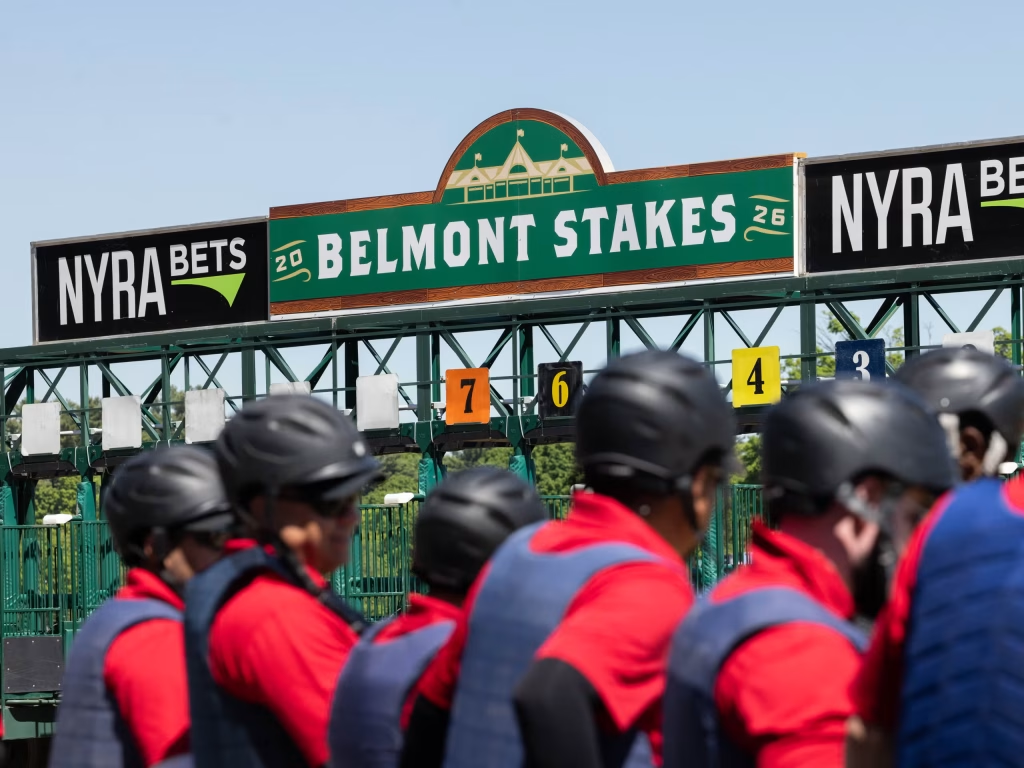
For nearly a century, the mile and a half of the Belmont Stakes has been one of American racing’s great measuring sticks.
That may no longer be guaranteed.
With the Belmont Stakes scheduled to return to a newly rebuilt Belmont Park in 2027, the expectation throughout the industry has been that the final jewel of the Triple Crown would also return to its traditional 1 1/2-mile distance. New York Racing Association President and CEO Dave O’Rourke, however, has made it clear that the subject remains open for discussion.
NYRA is considering whether the modern Belmont Stakes should continue to be run at 12 furlongs or whether the 1 1/4-mile configuration used during the race’s three-year stay at Saratoga might better fit the realities of the contemporary Thoroughbred industry.
The question cuts directly to the identity of a race long known as the “Test of the Champion.”
O’Rourke acknowledged the historical significance of the 1 1/2-mile distance, but also pointed to a breeding industry that has increasingly emphasized speed and commercial appeal rather than the kind of stamina traditionally required to win at 12 furlongs.
“If you’re looking at modernizing the whole thing, do you contemplate the mile and a half as well for the Belmont at some point here?” O’Rourke told Daily Racing Form. “I think that will be contemplated, whether it’s next year or in the future.”
His comments stop well short of announcing a change. But merely having the conversation represents a significant development for one of the oldest races in American Thoroughbred racing.

Saratoga Changed the Equation
The Belmont Stakes has been contested at Saratoga Race Course in each of the last three years while Belmont Park underwent its massive reconstruction.
Because of Saratoga’s track configuration, the race was shortened from 1 1/2 miles to 1 1/4 miles.
What began as a temporary necessity also produced an intriguing result.
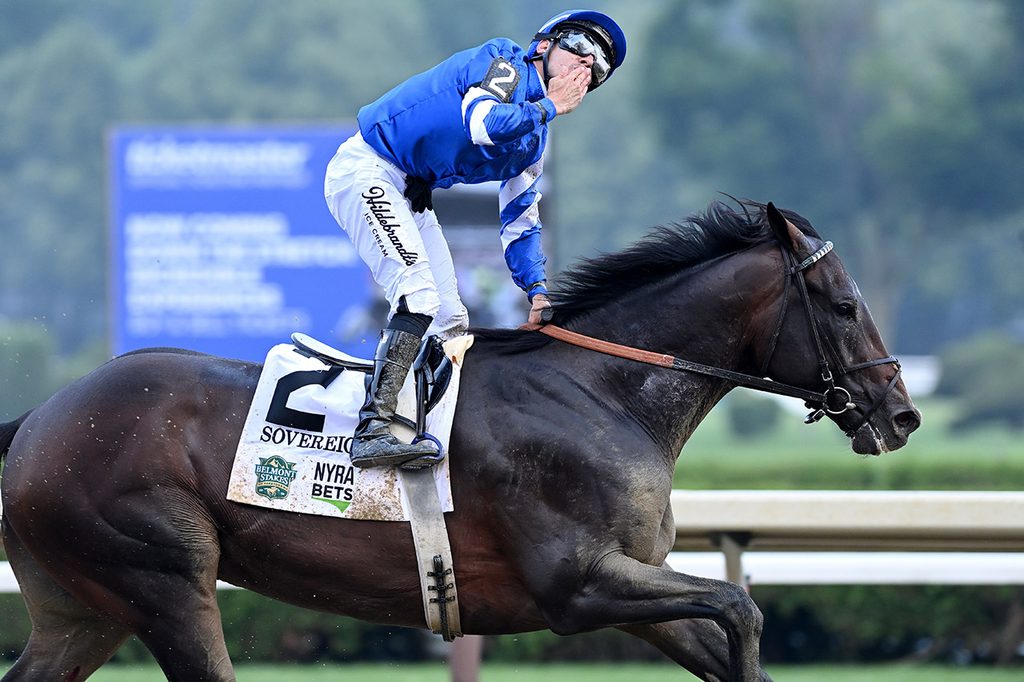
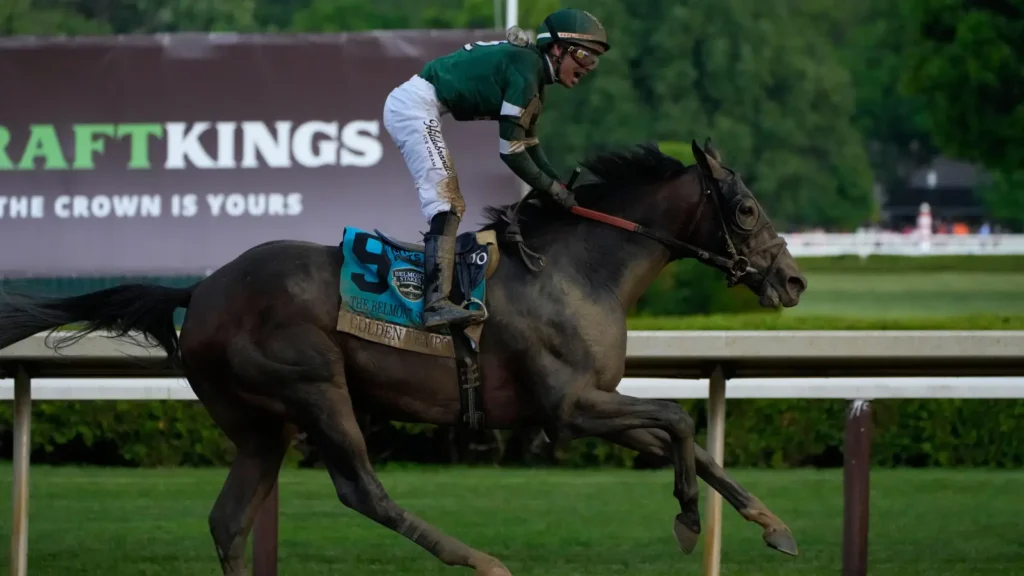
Kentucky Derby winners captured the Belmont in each of the last two seasons. Sovereignty won the 2025 Belmont after bypassing the Preakness, while Golden Tempo followed the same route in 2026, skipping the middle jewel before winning the Belmont five weeks after his Kentucky Derby victory.
Golden Tempo, trained by Cherie DeVaux and ridden by Jose Ortiz for Phipps Stable and St. Elias Stable, won the 158th Belmont Stakes in 2:03.49. Sovereignty had captured the 2025 renewal for Godolphin, trainer Bill Mott and jockey Junior Alvarado in 2:00.69.
Both races were contested at the same 1 1/4-mile distance as the Kentucky Derby.
That scheduling and distance combination gave connections something they rarely receive during the traditional Triple Crown grind: five weeks between major races without asking a horse to stretch from 10 furlongs to 12.
It is difficult to ignore how attractive that proposition has become in an era when the sport’s leading 3-year-olds routinely race less frequently than their predecessors.
A New Belmont Built With Options
The rebuilt Belmont Park is scheduled to return to racing Sept. 18, 2026, with the Belmont Stakes returning to Long Island on June 5, 2027.
The new main track itself remains a 1 1/2-mile oval.
Importantly, though, the design also gives NYRA greater flexibility should it elect to stage major races at 1 1/4 miles. The clubhouse turn was widened during the reconstruction, improving the configuration for 10-furlong races.
That detail becomes considerably more noteworthy now that NYRA is publicly acknowledging the possibility of a shorter Belmont Stakes.
For traditionalists, abandoning 1 1/2 miles would fundamentally change what separates the Belmont from the Kentucky Derby and Preakness. The distance has been the race’s defining characteristic for generations and has helped create some of the most memorable moments in Triple Crown history.
It should also be remembered that the Belmont has not always been a mile and a half. The inaugural running in 1867 was contested at 1 5/8 miles, and the now-familiar 1 1/2-mile distance was not permanently established until 1927.
Still, a century of history carries considerable weight.
Triple Crown Schedule Already Changing
The conversation surrounding the Belmont comes as the Triple Crown itself enters another period of adjustment.
According to O’Rourke, NYRA remains comfortable with the June 5 date scheduled for the 2027 Belmont Stakes and with the powerful stakes program that has been constructed around Belmont Day.
Moving later in June presents complications, including a potential conflict with the U.S. Open golf championship and an undesirable compression of the calendar approaching Saratoga.
There is also the larger issue of keeping the country’s best 3-year-olds competing against one another beyond the Triple Crown.
NYRA and Churchill Downs Incorporated announced the creation of the Thoroughbred Championship Series in August. Beginning in 2027, the six-race series is intended to create a season-long championship for the leading 3-year-olds and will include the Kentucky Derby and Belmont Stakes along with the Matt Winn at Churchill Downs, Jim Dandy and Travers at Saratoga, and another Churchill Downs event later in the season.
The stated objective is an important one.
American racing has struggled for years with divisions in which leading horses frequently take different paths following the Triple Crown. Rather than seeing the top members of a crop meet repeatedly during the summer and fall, championship contenders often avoid one another while trainers search for the most favorable individual spots.
The new series is designed to give connections a financial incentive to keep their best horses involved and, perhaps more importantly, give racing fans a recognizable cast of stars to follow throughout the season.
Tradition Versus the Modern Thoroughbred
That same philosophy now sits at the heart of the Belmont distance debate.
The argument for keeping the race at 1 1/2 miles is straightforward. The Belmont is supposed to be different.
The Kentucky Derby already provides the premier American test at 1 1/4 miles. Making the Belmont the same distance risks removing one of the defining challenges of the Triple Crown. For generations, the Belmont has demanded something different from a 3-year-old: stamina, tactical adaptability and the ability to handle a distance virtually none of the runners will have previously attempted.
That is precisely why winning it has always carried a special distinction.
The counterargument is equally relevant to the modern game.
American breeding and racing have steadily moved toward speed and shorter distances. Few important dirt races are contested at 1 1/2 miles, and relatively few horses are bred or campaigned with that distance as a primary objective.
O’Rourke questioned how relevant the traditional Belmont distance remains to the breeding industry, describing the mile and a half as a potential obstacle for the race.
That question is not going away.
The three Saratoga editions of the Belmont Stakes were born out of necessity, not an attempt to reinvent a Classic. But they provided NYRA with something far more valuable than a theoretical debate: three years of evidence showing what a 10-furlong Belmont Stakes looks like on the modern racing calendar.
Now the race is heading home.
Whether the mile and a half comes home with it may become one of the most consequential decisions American racing makes in the coming years.
For more than a century, the Belmont Stakes has asked a question no other American Classic asks.
The industry now has to decide whether it still wants the answer.